Early Literacy • Teacher Development • Tutorial Center Empowerment SEELS Japan–Philippines education-development pathway
SEELS Ph • Early Literacy and Education Talent Development

Build early literacy before learning gaps become harder to close.

SEELS develops teachers dedicated to early literacy and helps tutorial centers, small schools and community learning providers become trusted local partners for Filipino and English reading and writing foundations from birth to age six.

15+ years Japan–Philippines teacher-development experience
1,000+ SEELS teacher-training graduate records
0–6 focus A developmental continuum from language foundations to beginning literacy
93.1% Basic literacy among Filipinos aged 10–64 in the 2024 FLEMMS
70.8% Functional literacy among Filipinos aged 10–64 in the same survey
The literacy gap is measured later. Stronger foundations must begin earlier. FLEMMS measures functional literacy from ages 10–64. SEELS works upstream by strengthening the teachers, families and local learning providers closest to children during the early years.
The case for earlier action

The literacy gap is measured later—but the foundation begins earlier.

The 2024 Functional Literacy, Education and Mass Media Survey helps the country see the difference between basic literacy and the deeper ability to comprehend, connect information and make inferences. Among Filipinos aged 10 to 64, 93.1% had basic literacy while 70.8% met the functional-literacy measure.

Those figures describe outcomes later in life. They do not directly assess every young child, but they strengthen the case for earlier action. Language, listening, vocabulary, movement, sound awareness, meaningful print experiences and confidence begin developing long before a learner is formally identified as needing reading intervention.

Do not wait for remediation when stronger foundations can begin earlier.Early literacy is not formal reading from birth. It is a developmental continuum—from relationships, spoken language, songs and stories to sound-symbol work, handwriting, beginning reading, writing and comprehension when appropriate.

Official context: Philippine Statistics Authority, 2024 FLEMMS; Republic Act No. 12199 on the crucial 0–8 stage; and DepEd Kindergarten guidance on play-based emergent literacy. SEELS uses these sources as public context, not as government endorsement or as a diagnosis of every child.
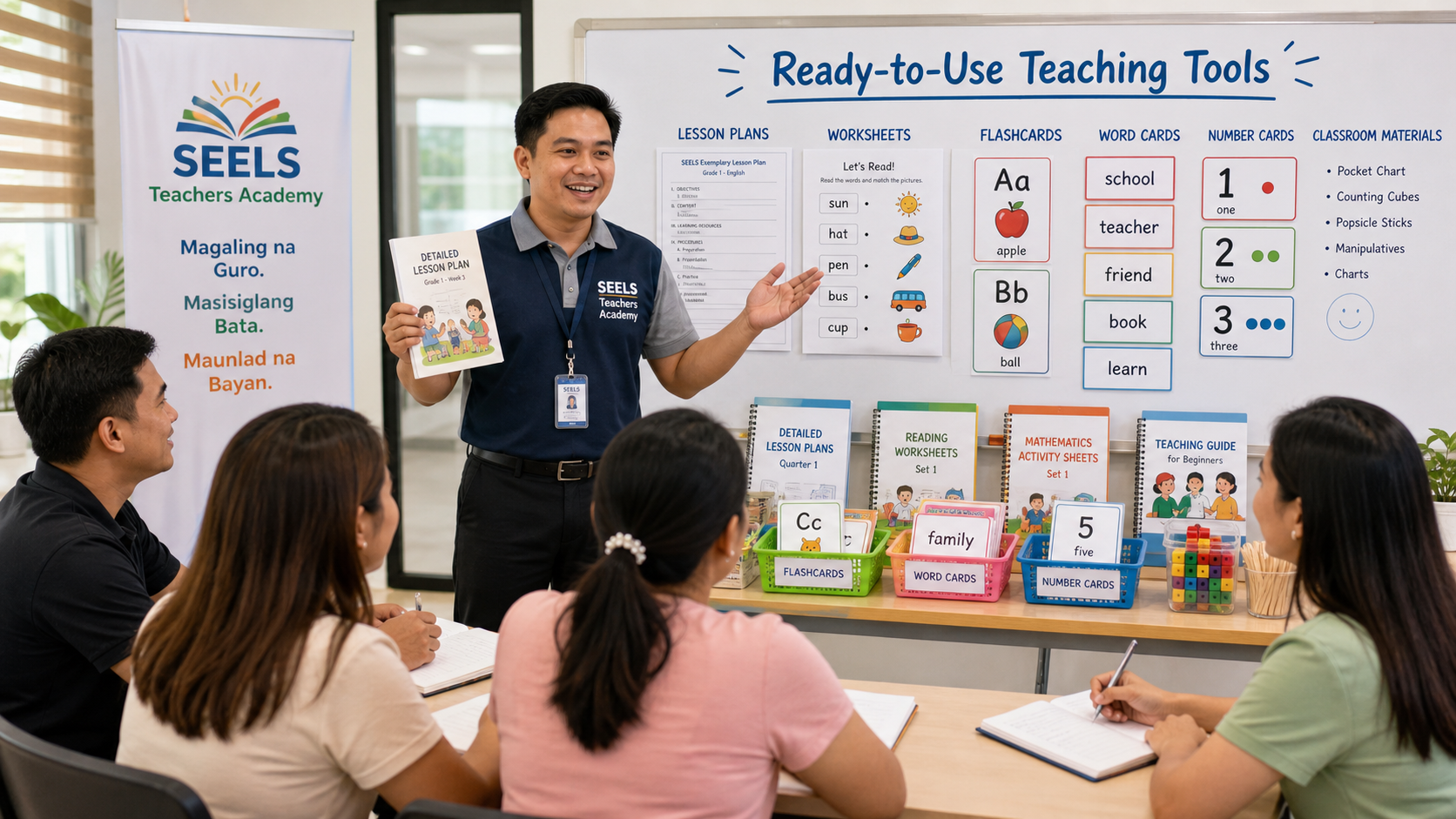
Early literacy teacher presenting language, reading and writing learning materials
Ages 0–6 require different teaching responses: rich spoken language and interaction first, followed by developmentally appropriate preparation for sound, print, reading, writing and comprehension.
Dedicated early-literacy teachers

Teachers need a pathway to specialize, practise and keep growing.

SEELS begins by recognizing teachers’ qualifications, commitment, experience and potential. The mission is not to question whether teachers are qualified, but to help more educators develop practical specialization in the language, reading and writing foundations of young children.

Understand the 0–6 Continuum

Learn how relationships, oral language, movement, sensory experience, sound awareness, print and beginning literacy develop across the early years.

Teach Filipino and English Responsibly

Value both languages equally while teaching each according to its own sound, syllable, spelling, word-building and communication structure.

Practise, Reflect and Improve

Strengthen training through demonstration, observation, supervised application, mentoring, portfolio evidence and continuing professional reflection.

Early literacy is not about forcing formal reading too soon. It is about preparing the child—and preparing the teacher—at the right time.

From birth, children need responsive conversation, songs, stories, movement and meaningful interaction. As they grow, teachers introduce vocabulary, sound awareness, fine-motor preparation, print, reading and writing in developmentally appropriate ways.

Teacher dedication grows when institutions invest in professional growth.

Continuing professional development is a normal part of teaching. DepEd’s professional standards connect teacher advancement with lifelong learning, while the ECCD Council publishes standards for center-based programs and competencies for child-development teachers and workers.

ETD therefore connects short-course learning with guided practice, suitable materials, observation, mentoring and institutional support. Teachers should not be left alone to translate theory into early-literacy practice.

References: DepEd Philippine Professional Standards for Teachers and ECCD Council center-based and teacher competency standards.
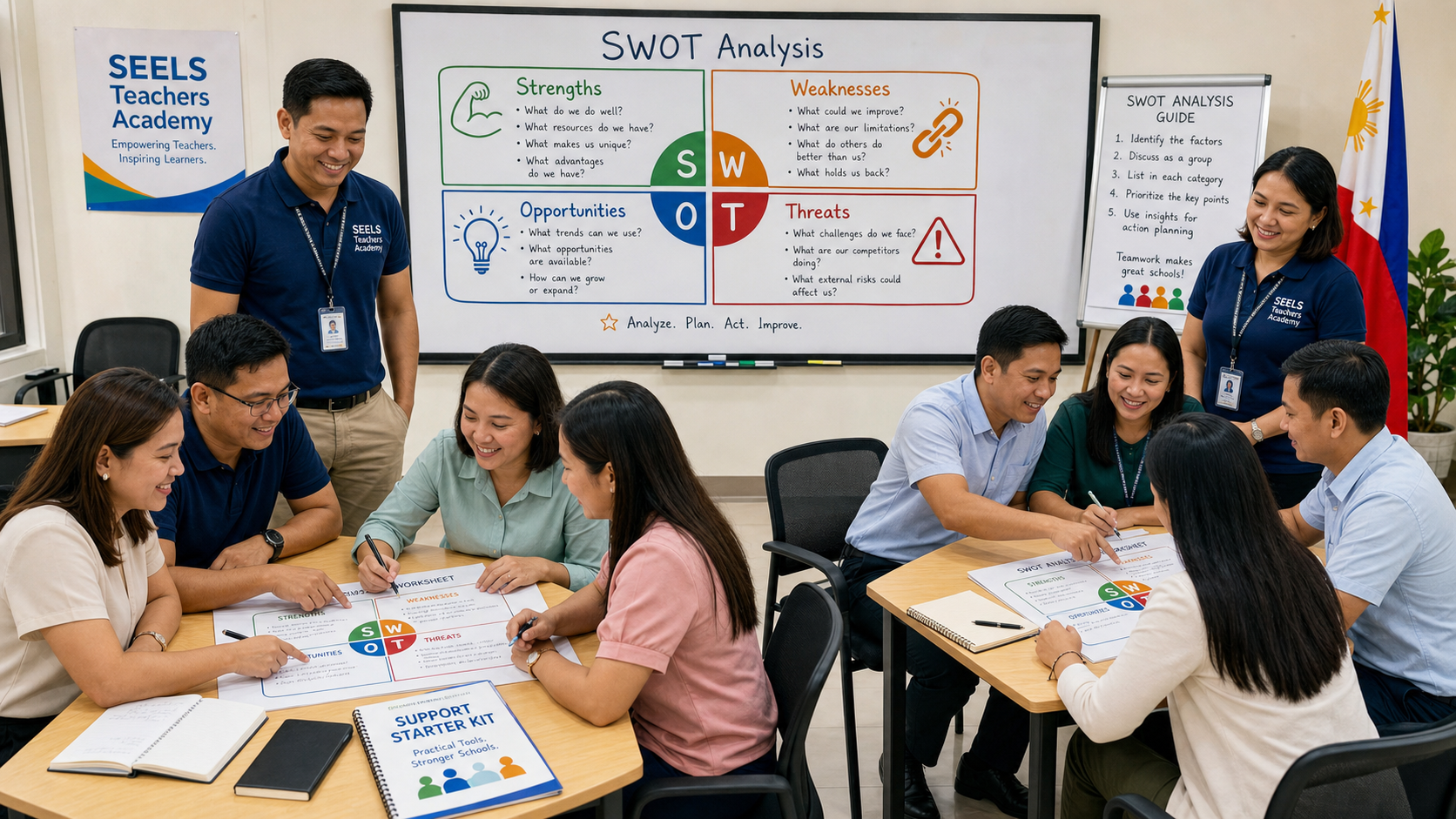
SEELS educators preparing an early literacy teaching and tutorial center pathway
A community literacy hub can begin with one prepared teacher, one age-appropriate program and one small group of children whose development is carefully observed and supported.
The silent education workforce

Tutorial centers can become neighborhood early-literacy hubs.

Tutorial centers and small learning providers are often the first places families approach when a child needs more time, closer attention, confidence-building or help with beginning reading and writing. Their contribution is real, but it is rarely articulated as part of a wider early-literacy ecosystem.

The opportunity is not simply to offer more homework help. It is to give these centers an institutional pathway for teacher development, structured Filipino and English literacy programs, learner assessment, mentoring, parent communication and quality review. Republic Act No. 12028 likewise recognizes the value of well-systematized tutorials, trained tutors and careful learner assessment, although independent tutorial centers are not automatically part of the government ARAL Program.

  • Develop tutors into teachers dedicated to early language, reading and writing foundations.
  • Move beyond general homework assistance and late remediation toward structured early support.
  • Use shared lesson sequences, observation tools, mentoring routines and learner-progress records.
  • Build a trusted niche around children ages 0–6 while complementing parents, ECCD programs, Kindergarten and schools.
SEELS early-literacy theory of change

Work upstream: strengthen the adults and institutions around the child.

FLEMMS reveals a later literacy outcome. ETD responds earlier by developing dedicated teachers and empowering local learning providers to give young children stronger language, reading and writing foundations.

1

Listen to the Child and Community

Understand the child’s age, language experience, family context, present abilities and the local provider’s real capacity.

2

Prepare Dedicated Teachers

Build knowledge of child development, oral language, literacy readiness, Filipino and English structures, teaching methods and reflection.

3

Organize the 0–6 Continuum

Match relationships, stories, movement, sound awareness, print, handwriting, reading and writing to the child’s developmental stage.

4

Empower Local Learning Centers

Strengthen tutorial centers and small schools with shared programs, materials, mentoring, parent communication and quality systems.

5

Guide Practice and Evidence

Use supervised teaching, learner starting points, work samples, progress records, mentor feedback and appropriate follow-up.

6

Contribute to Long-Term Literacy

Help more children enter formal learning with stronger foundations while building sustainable community education capacity.

Build the foundation early. Grow the teacher. Strengthen the center. Support the child. Build the community.The SEELS early-literacy social-impact direction
What mission-aligned impact looks like

Early-literacy development should change practice—not only issue certificates.

SEELS does not claim that one course or one tutorial center can solve the national literacy gap. Its contribution is to prepare more capable educators, strengthen local providers and document how young children are being supported.

For Teachers

A clearer early-literacy specialization, stronger lesson purpose, practical materials, observed teaching evidence, mentor feedback and a continuing-development plan.

For Learners

Developmentally appropriate support in oral language, vocabulary, sound awareness, movement, print, beginning reading, writing, comprehension, participation and confidence.

For Parents

Clearer explanations of what the child can do, why a learning activity is appropriate, what progress is visible and how the family can support learning at home.

For Tutorial Centers

A respected niche in reading and writing foundations, a stronger teacher pipeline, shared methods, safer practicum and evidence-led program growth.

For Small Schools

Better-connected early-years leadership, teacher formation, prepared environments, literacy pathways, parent orientation and quality review.

For Communities

More accessible local educators and learning spaces that complement formal systems and help families act before learning gaps become harder to address.

Two doors into one early-literacy mission

Develop the early-literacy teacher—and the institution that supports the teacher.

Individual educators need accessible formation and practice. Tutorial centers and small schools need staff development, program systems and quality support. ETD connects both sides so training can lead to responsible local implementation.

Pathway 1 • Individual

Become an Early-Literacy Teacher

For teachers, tutors, assistants, parents, education graduates and aspiring educators who want practical preparation for supporting language, reading and writing foundations.

  • Begin with the short course closest to your age group, language or teaching role.
  • Complete demonstrations, lesson outputs, reflection and assessment requirements.
  • Continue into practicum, capstone, mentoring or a longer professional pathway when applicable.
Explore Early-Literacy Teacher Programs
Pathway 2 • Institutional

Build an Early-Literacy Center or School Pathway

For owners, directors and coordinators who want to develop dedicated teachers, structured programs, supervised implementation, learner evidence, parent trust and a sustainable local literacy mission.

  • Begin with the children, families, teachers and literacy needs already present in the community.
  • Agree on training, program scope, safeguards, supervision, documentation and intended outcomes.
  • Start with one teacher team, one age group or one manageable pilot before wider expansion.
Explore Tutorial Center and School Development
Four short courses • One literacy-foundation mission

Choose the entry course that matches your role and learners.

The four ETD short courses address different parts of the same challenge: understanding the young child, strengthening oral language, preparing the environment, teaching Filipino and English foundations, using systematic methods and turning training into real lessons. They may be taken individually or organized as a staff-development pathway.

Young Learner Language and Teaching

TEYL Philippine Variant

Practical preparation for engaging young learners through child development, scaffolding, movement, stories, games, classroom language, participation and beginning English literacy.

  • Understand young learners, relationships and participation needs
  • Build oral language, listening and beginning English literacy
  • Plan lessons, practise microteaching and reflect on learner response
Program scope and certificate conditions follow the current SEELS announcement. Introductory Filipino literacy alignment does not automatically confer Tunog at Pantig implementer status.
View the TESOL–TEYL Pathway
Filipino and English Reading and Writing

Ginto at Pilak ng Wika

A coordinated literacy direction that values Filipino and English equally while teaching each language according to its own sound, syllable, spelling, word-building and meaning-making structure.

  • Tunog at Pantig Filipino reading and writing foundations
  • Systematic sound-based English literacy support
  • Learner starting-point checks, work samples and progress evidence
Filipino and English are presented without hierarchy as valuable languages for literacy, communication, learning, participation and human development.
Explore Tunog at Pantig
Prepared Environment and Pre-Literacy

Montessori Language and Jolly Phonics Introductory Course

A practical introduction connecting Montessori philosophy and observation with Practical Life, Sensorial preparation, spoken language, vocabulary, fine-motor work, pre-writing, sound-symbol learning and systematic phonics.

  • Understand the child, observation and the prepared environment
  • Support movement, sensory discrimination and fine-motor preparation
  • Connect spoken language, sound awareness, print and beginning literacy
This is an introductory course. It is not a Montessori diploma, complete Digital Montessori Education program or official Jolly trainer qualification.
View the Introductory Course
Systematic English Beginning Literacy

Jolly Phonics and Jolly Classroom App Training Support

Practical support for turning stories, actions, letter sounds, blending, segmenting, handwriting and app activities into active, teacher-guided English literacy lessons when developmentally appropriate.

  • Teach the five core Jolly Phonics skill areas
  • Prepare teacher-led on-screen and off-screen activities
  • Connect sound, word, sentence, handwriting and comprehension practice
SEELS practical support does not automatically grant official Jolly trainer status, trainer authorization, distributor appointment or an independent professional license.
Ask About Jolly Training Support
The niche market SEELS is building

Dedicated teachers and tutorial centers for reading and writing foundations.

SEELS does not seek to replace parents, ECCD centers, Kindergarten or formal schools. It strengthens the local education ecosystem around them by helping tutorial centers and small schools develop teachers, early-literacy programs and responsible systems for children who need preparation, practice or closer support.

For Tutorial Centers

Early Literacy Tutorial Center Human Resource Development

Help a tutorial center define a credible niche in Filipino and English reading and writing foundations while developing dedicated teachers and shared teaching systems.

  • Center literacy mission and staff-capability review
  • Four-course training plan based on learners and teacher readiness
  • Lesson sequences, observation, mentoring and professional portfolios
  • Parent communication, learner evidence and continuing staff development
Request an Early Literacy Center Consultation
For Preschools and Small Schools

Early Years and Digital Montessori School Development Pathway

Support a preschool or small school in connecting child development, prepared environments, teacher formation and Filipino and English literacy foundations through a manageable pilot and continuing review.

  • School vision, age-group and readiness review
  • Leadership orientation and teacher formation
  • Prepared-environment and literacy-materials plan
  • One-class or one-level pilot with quality follow-up
Ask About the DME Pathway
Flexible Community Development

Community Literacy, Practicum and Teacher-Pipeline Development

Institutions not ready for a full pathway may begin with one carefully defined project that builds local teacher capacity and supports one group of young learners.

  • Ginto at Pilak ng Wika or early-literacy pilot
  • Teacher and staff capability mapping
  • Supervised practicum and mentor preparation
  • Parent orientation and learner-progress documentation
Discuss a Small Early-Literacy Pilot
Recognition and regulatory scope SEELS institutional pathways provide professional training and development support within the stated program scope. They do not automatically provide AMI, AMS, TESDA, DepEd or other external accreditation, affiliation, authorization or recognition. Institutions remain responsible for permits, approvals and regulatory requirements applicable to their operations.
How a center becomes a literacy partner

Start with one age group, one teacher team and one evidence-led pilot.

Institutional development connects teacher formation with the children to be served, the local environment, supervision, safeguarding, parent communication and review.

Define the Local Need

Identify the children, age range, language needs, family concerns and the specific literacy problem the center can responsibly address.

Map Teacher and Center Readiness

Review staff experience, leadership, space, materials, schedule, safeguarding, budget and supervision capacity.

Choose the Right Entry Pathway

Select the short course, staff-development combination or institutional pilot that matches the present need.

Prepare Teachers and Materials

Train teachers, demonstrate lessons, prepare resources, agree on routines and clarify parent communication.

Pilot with Mentoring

Begin with a manageable group while observing teaching, documenting learner starting points and providing feedback.

Review Before Expansion

Examine teacher practice, learner evidence, parent understanding, center capacity and the next realistic stage of growth.

Evidence and accountability

Show how teachers, centers and learners are changing.

A credible early-literacy mission should be able to explain what teachers learned, what changed in practice, how children were supported, what parents understood and whether the center is ready to continue or expand.

Teacher Formation

Course completion, assignments, lesson plans, demonstrations, reflections and age-appropriate teaching decisions.

Observed Practice

Classroom or tutorial observation, mentor feedback and demonstrated early-literacy competencies.

Professional Portfolio

Teaching materials, practicum records, learner evidence, reflection and a continuing-improvement plan.

Learner Starting Point

Appropriate checks of oral language, participation, sound awareness, print, reading or writing according to age and program scope.

Learner Progress

Work samples, teacher records, reading and writing evidence, follow-up results and developmentally appropriate next steps.

Parent Partnership

Clear explanation of goals, learner response, visible progress, concerns and useful home support.

Teacher Pipeline

Trainees observed, mentors prepared and potential teacher readiness documented for future center needs.

Institutional Review

Implementation findings, safeguarding, capacity gaps, quality recommendations and readiness before expansion.

Supervised early-literacy practicum

A protected learning placement—not free labor or staff replacement.

SEELS practicum helps trainees translate early-literacy learning into responsible practice. They may observe, assist, prepare materials, demonstrate selected language or literacy activities, build portfolio evidence and respond to mentor feedback.

Before a placement begins, SEELS and the partner institution should agree on the age group, schedule, supervision, permitted activities, learner safeguards, consent, confidentiality, documentation and evaluation process.

  • Observe approved early-years classes or tutorial sessions.
  • Assist the designated supervising teacher or mentor.
  • Prepare developmentally appropriate language and literacy materials.
  • Demonstrate selected activities under direct guidance.
  • Complete portfolio, capstone or practicum evidence.
  • Receive, reflect on and respond to professional feedback.
How the SEELS early-literacy ecosystem connects

One mission with clearly identified functions.

ETD

SEELS Philippines

The public and institutional-development platform connecting the early-literacy mission, partnerships, tutorial-center development, pilots, practicum systems and community implementation.

Training

SEELS Teachers Academy

The teacher-formation and assessment arm delivering short courses, professional pathways, teaching resources, demonstrations, assignments, mentoring and certificates.

Local Practice

Partner Schools and Learning Centers

Local institutions supporting supervised practicum, pilot classes, teacher development, parent engagement and evidence-based follow-up under agreed arrangements.

Growing early-literacy partner network

Schools and learning centers helping build the local literacy ecosystem

Partner institutions help connect teacher formation with local learners, supervised practice and community implementation. Roles, schedules, practicum participation and learner capacity are confirmed separately for each institution and training batch.
A listing recognizes participation in the growing network; it does not mean that an institution accepts practicum trainees or implements every SEELS program in every batch. Availability, supervision and permitted activities require separate confirmation.

Choose your first contribution

Prepare one teacher. Strengthen one center. Reach one group of children.

Begin with the role you can realistically play now: train as an early-literacy educator, develop your tutorial-center staff, organize one preschool or school pilot, host supervised practicum or discuss a community literacy partnership.

Frequently asked questions

Direct answers about SEELS, early literacy and tutorial-center development.

What is SEELS Philippines?
SEELS Philippines is an education-development and professional-training platform. Its early-literacy mission prepares teachers and helps tutorial centers, small schools and community learning providers strengthen Filipino and English language, reading and writing foundations.
Why does SEELS focus on early literacy from birth to age six?
The functional-literacy gap is measured later, but language, listening, vocabulary, movement, sound awareness, print experience and learning confidence develop much earlier. SEELS therefore works upstream while matching every activity to the child’s developmental stage.
How does the 2024 FLEMMS relate to the SEELS mission?
FLEMMS reported that 93.1% of Filipinos aged 10–64 had basic literacy while 70.8% met the functional-literacy measure. SEELS uses this national finding as a reason for earlier, long-term action—not as a direct assessment of every young child, teacher, school or tutorial center.
What role can tutorial centers play in early literacy?
Tutorial centers are close to families and can provide additional time, smaller groups and targeted support. With trained teachers, structured programs, learner starting-point checks, mentoring, parent communication and quality review, they can become trusted neighborhood early-literacy hubs.
Does early literacy mean formal reading instruction from birth?
No. From birth, early literacy begins with secure relationships, conversation, listening, songs, stories, play, movement and meaningful interaction. Sound-symbol work, blending, handwriting and early reading are introduced later when developmentally appropriate.
What are the four short courses under ETD?
The four entry courses are the TEYL Philippine Variant; Ginto at Pilak ng Wika; the Montessori Language and Jolly Phonics Introductory Course; and Jolly Phonics and Jolly Classroom App Training Support. Each addresses a different part of one literacy-foundation mission.
How does SEELS help teachers continue growing professionally?
SEELS recognizes teachers’ qualifications, commitment, experience and potential. ETD adds practical specialization through short courses, demonstrations, guided practice, mentoring, reflection, portfolio evidence and continuing institutional support.
How can a tutorial center or small school begin?
A provider may begin with a consultation, one teacher team, one age group, one short course, one supervised literacy class or one pilot. Expansion should follow evidence of teacher readiness, learner support, safeguarding and institutional capacity.
Is supervised practicum free labor or staff replacement?
No. SEELS practicum is a protected educational placement. Trainees observe, assist and demonstrate selected activities under supervision. They must not replace regular paid teachers or be left unsupervised with children.
Are SEELS ETD programs college degrees or automatic professional licenses?
No. SEELS ETD provides non-degree professional training and institutional development unless a specific authorized offering clearly states otherwise. Course completion does not automatically grant government licensure, official Montessori recognition, Jolly trainer authorization, employment or business income.
Evidence and source note. The homepage direction is informed by the 2024 FLEMMS results, Republic Act No. 12199 on the crucial 0–8 developmental stage, DepEd guidance on play-based emergent literacy, Republic Act No. 12028 on systematic tutorials and trained tutors, and DepEd professional standards for continuing teacher growth. These sources provide public context and do not constitute government endorsement, accreditation or a guarantee of outcomes.