Flagship SBRW • Bite-Size Montessori • Teacher Development • Tutorial Center Empowerment

SEELS Japan–Philippines education-development pathway • info@seels.ph

SEELS Philippines • Early Literacy and Education Talent Development

Build early literacy before learning gaps become harder to close.

SEELS develops teachers dedicated to early literacy and helps tutorial centers, small schools, LGUs, government agencies and community learning providers become stronger local partners for Filipino and English language, reading and writing foundations. At the center of this mission is the SEELS Strong Beginning Reading & Writing (SBRW) Classroom—our flagship implementation system connecting prepared teachers, structured literacy pathways, learner evidence and parent communication.

Flagship SBRW classroom implementation Bite-Size Montessori shared early foundation Teacher formation and specialization Institutional and public partnership Practice, evidence and community capacity
15+ Years Japan–Philippines teacher-development experience
1,000+ SEELS teacher-training graduate records
0–6 Focus Including Bite-Size Montessori shared preparation around ages 2.5–4
One Ecosystem Teachers, families, providers, LGUs and community partners
SEELS Flagship Literacy Program

One classroom implementation system • Two language pathways

SEELS Strong Beginning Reading & Writing

It Takes a School Community to Raise a Reader.
School-led • Family-supported • SEELS-enabled

SBRW helps a participating school organize a strong beginning in reading and writing around the child. The school leads implementation, teachers provide structured instruction, families reinforce learning through appropriate home support, and SEELS provides training, implementation resources, progress-review tools and continuing quality support.

Within one supported classroom system, SBRW connects Montessori-informed preparation, speaking and listening, systematic English and Filipino literacy instruction, reading and writing application, learner observation, parent communication and visible evidence of progress.

Shared Early Foundation: Bite-Size Montessori

Before more explicit English or Filipino reading and writing, Bite-Size Montessori can help prepare younger children through Practical Life, Sensorial experiences, oral language, movement, sound awareness, fine-motor control, pre-writing and early number readiness. It provides the shared Montessori-informed developmental foundation beneath both language pathways when appropriate to the child’s age, readiness and learning needs.

Explore Bite-Size Montessori →
English Literacy Pathway

JCAT → Jolly Phonics through Jolly Classroom

JCAT prepares participating teachers to use Jolly Phonics through the teacher-led Jolly Classroom platform as a major English literacy instructional engine within SBRW. Lessons connect on-screen guidance with speaking, movement, handwriting, reading, spelling and other meaningful off-screen activities.

Sounds Letters Blend Segment Read Write
Explore the English teacher pathway →
Filipino Literacy Pathway

Tunog at Pantig

Tunog at Pantig is the SEELS Filipino reading-and-writing pathway. It follows the sound, syllable and word structure of Filipino rather than treating Filipino literacy as a translation of an English phonics sequence.

Tunog Titik Pantig Salita Pagbasa Pagsulat
Explore the Filipino teacher pathway →
What makes SBRW the flagship

Training becomes a school-community classroom journey.

SBRW is not simply another short course. It is an implementation pathway for schools ready to work consistently with enrolled learners and their families. The school organizes the program, teachers carry out instruction and observation, families support appropriate practice at home, and SEELS strengthens implementation through resources, mentoring, progress-review frameworks and quality assurance.

1 Prepare
2 Teach
3 Practise
4 Observe
5 Review
6 Continue
School-led implementation Family-supported learning SEELS-enabled quality support Bite-Size Montessori shared foundation Speaking & listening Teacher-led literacy instruction Meaningful off-screen application Learner portfolio & evidence Parent progress communication Peer learning & quality assurance

Jolly Phonics and Jolly Classroom are products and trademarks of Jolly Learning Ltd. JCAT is a SEELS onboarding and support course. SBRW, Bite-Size Montessori and Tunog at Pantig are SEELS implementation frameworks and resources. SBRW is not an official Jolly Learning certification, franchise or guarantee of learner outcomes.

Where to Start

Choose the pathway closest to your role.

SBRW is the flagship literacy implementation program, while teacher training, institutional development, public partnership and professional formation remain important entry pathways around it. These folders help you begin through the role most relevant to you.

93.1% Basic literacy among Filipinos aged 10–64 in the 2024 FLEMMS.
70.8% Functional literacy among Filipinos aged 10–64 in the same survey.
90.0% Basic literacy among Filipinos aged 5 years and over under the survey’s broader age basis.
0–8 Recognized in Republic Act No. 12199 as the first crucial stage of educational development.
The Case for Earlier Action

The literacy gap is measured later—but the foundation begins earlier.

The 2024 Functional Literacy, Education and Mass Media Survey helps the country see the difference between basic skills and the deeper ability to comprehend, connect information and make inferences. Those figures describe later outcomes; they do not directly assess every young child.

SEELS works upstream by strengthening the teachers, families, tutorial centers, schools and public or community partners closest to children. Early literacy does not mean forcing formal reading from birth. It develops through responsive relationships, spoken language, songs, stories, movement and meaningful interaction before developmentally appropriate sound, print, handwriting, reading and writing work.

Public context: Philippine Statistics Authority 2024 FLEMMS , Republic Act No. 12199 , and Republic Act No. 12028 . These sources provide public context and do not constitute government endorsement, accreditation or a guarantee of outcomes.
Bite-Size Montessori shared early-childhood foundation
Shared Early Childhood Foundation

Bite-Size Montessori prepares the child before more explicit Reading & Writing.

SEELS responds to the need for stronger early foundations by bringing practical Montessori principles closer to families, teachers, tutorial centers, schools and communities. Bite-Size Montessori is designed primarily for approximately ages 2.5–4 and supports both Filipino and English learning rather than belonging to only one language pathway.

Through Practical Life, Sensorial experiences, oral language, movement, sound awareness, fine-motor development, pre-writing and early number readiness, children build capacities that can support later Reading & Writing when developmentally ready.

Approx. Birth–2.5 Relationships, spoken language, stories, songs, movement and meaningful experience.
Approx. 2.5–4 Bite-Size Montessori shared preparation through hands, senses, language, movement and independence.
Approx. 4–6 • Readiness-Based More explicit Filipino or English Reading & Writing according to language and learner readiness.
SEELS Early-Literacy Theory of Change

Work upstream: strengthen the adults and institutions around the child.

SEELS does not claim that one course or one center can solve a national challenge. Its contribution is to prepare more capable educators, strengthen local providers and document how children are being supported.

1

Listen to the Child and Community

Understand age, language experience, family context, present abilities, local need and provider capacity.

2

Prepare Dedicated Adults

Build child-development, Montessori-informed observation, oral-language, Reading & Writing readiness, Filipino and English teaching, and reflection skills.

3

Organize the 0–6 Developmental Continuum

Begin with relationships and spoken language, use Bite-Size Montessori for shared preparation around approximately ages 2.5–4, and move toward more explicit Filipino or English Reading & Writing when ready.

4

Empower Local Learning Providers

Strengthen tutorial centers and small schools through shared programs, materials, mentoring, parent communication and quality systems.

5

Guide Practice and Evidence

Use supervised teaching, learner starting points, work samples, progress records, mentor feedback and appropriate follow-up.

6

Contribute to Long-Term Literacy

Help children enter formal learning with stronger foundations while building sustainable local education capacity.

Prepare early through relationships and Bite-Size Montessori. Grow the teacher. Strengthen the center. Support Filipino and English Reading & Writing. Build the community.

SEELS Institutional Reference

Open only the subject you need.

The deeper mission, programs, public-partnership scope, evidence, safeguards and institutional information remain on the homepage, but are organized into folders so visitors do not have to process everything at once.

Why Early Reading & Writing and the 0–6 Continuum Language, movement, sound, print and developmentally appropriate preparation before later remediation

Do not wait for remediation when stronger foundations can begin earlier.

Early literacy is not formal reading from birth. It is a developmental continuum beginning with relationships, responsive conversation, songs, stories, play, movement and meaningful interaction. Vocabulary, sound awareness, fine-motor preparation, print, handwriting, reading, writing and comprehension are introduced later when appropriate.

Shared Preparation • Approx. Ages 2.5–4

Bite-Size Montessori

This is the named SEELS shared Montessori-informed foundation between the child's earliest language environment and later, more explicit Filipino or English Reading & Writing. It brings Practical Life, Sensorial work, oral language, sound awareness, movement, fine-motor preparation, pre-writing and early number readiness into one understandable early-childhood framework.

Explore Bite-Size Montessori

Relationships and Spoken Language

Children first need responsive adults, shared attention, listening, turn-taking, songs, stories and meaningful words connected with daily life.

Movement and Sensory Experience

Purposeful movement, practical activity, visual and auditory discrimination, coordination and fine-motor work support later language and writing tasks.

Sound and Print Awareness

Children gradually notice environmental sounds, speech sounds, rhymes, syllables, symbols, books and meaningful print without turning every experience into a test.

Beginning Reading and Writing

Sound-symbol work, blending, segmenting, handwriting, word-building, reading, writing and comprehension require appropriate readiness, sequence and teacher guidance.

Early literacy is not about forcing formal reading too soon. It is about preparing the child—and preparing the teacher—at the right time.

Public-context clarification

National literacy findings are used as a reason for earlier, long-term action. They are not a direct diagnosis of every young child, family, teacher, school or tutorial center.

Teacher Formation and Professional Growth Specialization, guided practice, demonstration, observation, reflection and continuing development

Teachers need a pathway to specialize, practise and keep growing.

SEELS begins by recognizing teachers’ qualifications, commitment, experience and potential. The mission is not to question whether teachers are qualified, but to help more educators develop practical specialization in young children’s language, reading and writing foundations.

Understand the Developmental Continuum

Learn how relationships and spoken language begin the continuum, how Bite-Size Montessori supports shared preparation around ages 2.5–4, and how more explicit Reading & Writing follows readiness.

Teach Filipino and English Responsibly

Value both languages equally while teaching each according to its own sounds, syllables, spelling, word-building and communication structures.

Practise, Reflect and Improve

Strengthen course learning through demonstrations, observation, supervised application, mentoring, portfolio evidence and continuing reflection.

What mission-aligned teacher impact looks like

Clearer Lesson Purpose

The teacher can explain what the child is developing, why the activity is appropriate and what should happen next.

Practical Materials and Methods

Training becomes visible in prepared activities, teacher language, classroom routines and learner participation.

Observed Teaching Evidence

Lesson demonstrations, classroom observation and mentor feedback show how theory is translated into practice.

Continuing-Development Plan

Course completion leads toward appropriate practice, mentoring, a pilot, practicum, capstone or a longer pathway.

Institutional responsibility

Teacher dedication grows when institutions invest in professional growth, suitable materials, observation, mentoring, supervision and realistic time for implementation. Teachers should not be left alone to translate theory into an entire early-literacy system.

Tutorial Centers, Preschools and Small Schools Human-resource development, structured programs, local pilots, parent trust and quality review

Tutorial centers can become neighborhood early-literacy hubs.

Tutorial centers and small learning providers are often the first places families approach when a child needs more time, closer attention, confidence-building or help with beginning reading and writing. The opportunity is to move beyond general homework assistance toward teacher development, structured Filipino and English literacy, learner evidence, parent communication and continuing quality support.

Early Literacy Tutorial Center HRD

Define a credible niche in reading and writing foundations while developing dedicated teachers, shared lesson systems, observation routines and professional portfolios.

Preschool and Small-School Development

Connect child development, prepared environments, leadership orientation, teacher formation and Filipino and English literacy through one class or level before expansion.

Flexible Community Development

Institutions not ready for a full pathway may begin with one literacy pilot, capability map, parent orientation or teacher-pipeline project.

Parent and Learner Evidence

Trusted providers explain learner starting points, visible progress, concerns, home support and the limits of the program honestly.

How a center becomes a responsible literacy partner

1. Define the Local Need

Identify the learners, age range, language needs, family concerns and specific problem the provider can address.

2. Map Teacher and Center Readiness

Review staff experience, leadership, space, materials, schedule, safeguarding, budget and supervision capacity.

3. Choose the Right Entry Pathway

Select the short course, staff-development combination or institutional pilot that matches the present need.

4. Prepare Teachers and Materials

Train teachers, demonstrate lessons, prepare resources, agree on routines and clarify parent communication.

5. Pilot with Mentoring

Begin with a manageable group while observing teaching, documenting learner starting points and providing feedback.

6. Review Before Expansion

Examine practice, learner evidence, parent understanding, safeguarding and institutional capacity before growth.

Recognition and regulatory scope

SEELS institutional pathways provide professional training and development support within the stated scope. They do not automatically provide AMI, AMS, TESDA, DepEd or other external accreditation, affiliation, authorization or recognition. Institutions remain responsible for permits, approvals and regulations applicable to their operations.

LGU and Government Partnership Public capability building, ECCD support, local pilots, teacher pipelines, evidence and defined institutional roles

Public partnership should build local capacity—not only hold one event.

LGUs and government agencies may work with SEELS on clearly defined early-childhood, literacy, teacher-development or community-provider objectives. The strongest partnership begins with the local need, public mandate, target population, available institutions and measurable outputs.

Local Needs and Capability Mapping

Review ECCD and literacy needs, existing teachers, child development workers, tutorial providers, schools, facilities, parent concerns and possible delivery partners.

Teacher and Service-Provider Development

Organize training that matches actual public responsibilities rather than offering a generic course detached from the learners and institutions to be served.

One Defined Pilot

Begin with one barangay, one center cluster, one age group, one teacher team or one community literacy activity before wider municipal or city expansion.

Public Evidence and Review

Agree on participation, teacher outputs, learner evidence, parent communication, safeguarding, documentation, findings and recommendations before the program begins.

Possible collaboration areas

  • ECCD and early-literacy teacher capability building
  • Filipino and English language, reading and writing pilots
  • Parent and caregiver literacy orientation
  • Tutorial-center and community-learning-provider development
  • Teacher, tutor, assistant and mentor pipeline mapping
  • Supervised practicum and local learning-site preparation
  • Digital learning and classroom-technology orientation
  • Monitoring, documentation and implementation review

Partnership clarification

A meeting, memorandum or framework agreement does not automatically activate every course, placement or local project. Each activity requires separate confirmation of scope, schedule, budget, learners, personnel, safeguarding, roles, approvals and expected evidence.

Mission-Aligned Impact and Accountability What change should become visible for teachers, learners, parents, centers, schools and communities

Early-literacy development should change practice—not only issue certificates.

SEELS is a financially disciplined social enterprise that treats early-childhood literacy as a shared responsibility. Its contribution is to prepare educators, strengthen local providers and document what is changing around the child.

For Teachers

Clearer specialization, stronger lesson purpose, practical materials, observed teaching evidence, mentor feedback and a continuing-development plan.

For Learners

Developmentally appropriate support in oral language, vocabulary, sound awareness, movement, print, reading, writing, comprehension, participation and confidence.

For Parents

Clearer explanations of what the child can do, why an activity is appropriate, what progress is visible and how the family can support learning.

For Tutorial Centers

A respected reading-and-writing niche, a stronger teacher pipeline, shared methods, safer practicum and evidence-led program growth.

For Small Schools

Better-connected early-years leadership, teacher formation, prepared environments, literacy pathways, parent orientation and quality review.

For Communities and Public Partners

More accessible local educators and learning spaces that complement formal systems and help families act before gaps become harder to address.

Read the SEELS Literacy Foundations Piggy Bank business ethos

Flagship Program, Training and Entry Courses SBRW as the classroom implementation flagship, with Bite-Size Montessori, teacher-development and language-specific pathways

Start with the flagship or the preparation pathway that matches your role.

SBRW is the SEELS classroom implementation flagship. Bite-Size Montessori provides the shared early-childhood foundation, while IC, TEYL, JCAT and Tunog at Pantig develop adults and language-specific teaching capability. These are related pathways, not a forced sequence, and may be taken according to learner, teacher and institutional need.

Flagship Classroom Implementation

SEELS Strong Beginning Reading & Writing (SBRW)

A teacher-led literacy implementation system connecting the English pathway through JCAT/Jolly Classroom and the Filipino pathway through Tunog at Pantig with learner observation, parent communication, evidence, review and continuing support.

Explore SBRW
Shared Early Childhood Foundation

Bite-Size Montessori

Designed primarily for approximately ages 2.5–4, Bite-Size Montessori prepares Practical Life, Sensorial learning, oral language, sound awareness, movement, fine-motor control, pre-writing, reading readiness and number readiness before more explicit Filipino or English Reading & Writing.

It also supports SEELS' public-awareness mission to bring foundational Montessori philosophy and methods closer to more children and adults.

Explore Bite-Size Montessori
Bite-Size Montessori shared foundation for early Reading and Writing
Young Learner Language and Teaching

TEYL Philippine Variant

Practical preparation for engaging young learners through child development, scaffolding, movement, stories, games, classroom language, participation and beginning English literacy.

  • Understand young learners and participation needs
  • Build oral language, listening and beginning literacy
  • Plan lessons, practise microteaching and reflect
Introductory Filipino literacy alignment does not automatically confer Tunog at Pantig implementer status.
View TEYL details
Filipino Reading and Writing Foundations

Tunog at Pantig

A Filipino literacy pathway that values Filipino and English equally while teaching each language according to its own sounds, syllables, spelling, word-building and meaning.

  • Filipino reading and writing foundations
  • Coordination with English beginning-literacy support
  • Starting-point checks and learner evidence
Filipino and English are presented without hierarchy as valuable languages for learning and participation.
Explore Tunog at Pantig
Teacher Foundation

Montessori Language and Jolly Phonics Introductory Course

A practical introduction connecting Montessori philosophy and observation with Practical Life, Sensorial preparation, spoken language, vocabulary, fine-motor work, pre-writing, sound-symbol learning and phonics.

  • Understand the child and prepared environment
  • Support movement, sensory and fine-motor preparation
  • Connect spoken language, sound, print and literacy
This introductory course is not a Montessori diploma, complete DME program or official Jolly trainer qualification. After IC, participants who want greater confidence in Montessori philosophy, observation, the prepared environment and classroom application are encouraged to continue through DME.
View the introductory course
Systematic English Beginning Literacy

Jolly Phonics and Jolly Classroom App Training Support

Practical support for turning stories, actions, sounds, blending, segmenting, handwriting and app activities into active, teacher-guided English literacy lessons.

  • Prepare teaching around the five core phonics skills
  • Use teacher-led on-screen and off-screen activities
  • Connect sound, word, sentence and handwriting practice
Participation does not automatically grant official Jolly trainer status, authorization or distributor appointment.
View Jolly Classroom support training

After training

Graduates and providers may continue through SBRW implementation where appropriate, basic peer support, shared resources, school collaboration, practicum preparation and professional pathways toward DME or the 120-Hour TESOL. Course, subscription, implementation and certificate conditions remain subject to each current written announcement.

Compare All SEELS Programs Explore After-Training Support

Evidence, Practicum and Non-Negotiable Safeguards Teaching outputs, learner evidence, supervision, consent, privacy and protected learning placements

Show how teachers, centers and learners are changing.

A credible early-literacy mission should be able to explain what teachers learned, what changed in practice, how children were supported, what parents understood and whether the provider is ready to continue or expand.

Teacher Formation

Course completion, assignments, lesson plans, demonstrations, reflections and age-appropriate teaching decisions.

Observed Practice

Classroom or tutorial observation, mentor feedback and demonstrated early-literacy competencies.

Professional Portfolio

Teaching materials, practicum records, learner evidence, reflection and a continuing-improvement plan.

Learner Starting Point and Progress

Appropriate checks of language, participation, sound, print, reading or writing, followed by work samples and next steps.

Parent Partnership

Clear explanation of goals, learner response, visible progress, concerns and useful home support.

Institutional Review

Implementation findings, safeguarding, capacity gaps, quality recommendations and readiness before expansion.

Supervised practicum is a protected learning placement—not free labor or staff replacement.

Trainees may observe, assist, prepare materials, demonstrate selected language or literacy activities, build portfolio evidence and respond to mentor feedback. Before placement, SEELS and the partner institution should agree on the age group, schedule, supervision, permitted activities, learner safeguards, consent, confidentiality, documentation and evaluation.

Permitted Learning Activities

Observe approved sessions, assist the designated teacher, prepare appropriate materials, demonstrate selected work under guidance and complete portfolio evidence.

Professional Feedback

Trainees receive, reflect on and respond to feedback without claiming independent authority beyond the approved scope.

Non-negotiable safeguards

  • Trainees must not replace regular paid teachers.
  • Trainees must not be left unsupervised with children.
  • Consent is required for learner photos or recordings.
  • Child dignity, privacy, safety and development come first.
  • Activities must follow SEELS and partner guidelines.
  • Practicum does not guarantee employment or placement.

Practicum is not manpower deployment

Practicum is not employment or a substitute for regular paid work. Child-protection and privacy requirements take priority over portfolio, documentation or promotional needs.
SEELS Ecosystem and FAQ Clearly identified functions and direct answers about scope, recognition and institutional roles

One mission with clearly identified functions.

SEELS Philippines, SEELS Teachers Academy and local partner institutions contribute different functions. Their roles, schedules, learner capacity, practicum participation and program implementation are confirmed separately.

SEELS Philippines

The public and institutional-development platform connecting the early-literacy mission, partnerships, provider development, pilots, practicum systems and community implementation.

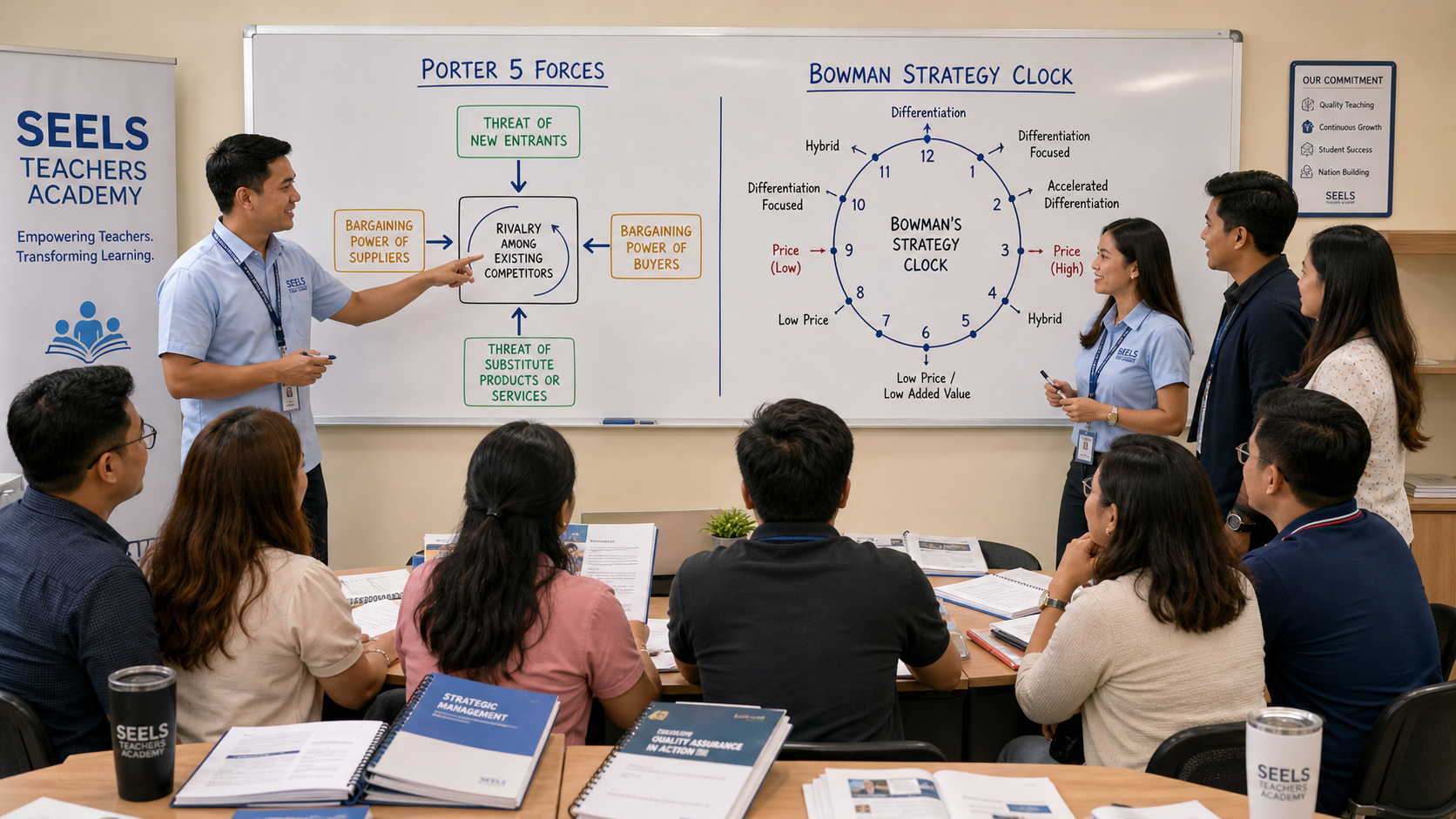
SEELS Teachers Academy

The teacher-formation and assessment arm delivering courses, professional pathways, resources, demonstrations, assignments, mentoring and certificates.

Partner Schools and Learning Centers

Local institutions supporting agreed teacher development, supervised practice, pilot classes, parent engagement and evidence-based follow-up.

Frequently asked questions

What is SEELS Philippines?

SEELS Philippines is an education-development and professional-training platform. It prepares teachers and helps tutorial centers, schools, public institutions and community providers strengthen Filipino and English language, reading and writing foundations.

Why focus on the early years?

Literacy gaps are often measured later, but language, listening, vocabulary, movement, sound awareness, print experience and confidence develop much earlier. Activities must still match the child’s developmental stage.

Where does Bite-Size Montessori fit in the SEELS pathway?

Bite-Size Montessori is the shared Montessori-informed early-childhood foundation, designed primarily for approximately ages 2.5–4. It develops oral language, movement, sensorial discrimination, independence, sound awareness, fine-motor control, pre-writing and early number readiness. As children become ready, these foundations can support Filipino Reading & Writing through Tunog at Pantig and English Reading & Writing through Jolly Phonics and Jolly Classroom.

Does early literacy mean formal reading from birth?

No. It begins with relationships, conversation, listening, songs, stories, play, movement and meaningful interaction. Formal sound-symbol, handwriting and reading work comes later when appropriate.

What role can tutorial centers play?

With trained teachers, structured programs, starting-point checks, mentoring, parent communication and quality review, centers can become trusted neighborhood literacy providers that complement families and formal schools.

How can an LGU or government agency begin?

Begin with a defined population and public need, identify existing institutions and personnel, agree on roles and evidence, and test one manageable capability-building or literacy pilot before wider expansion.

Is supervised practicum free labor?

No. It is a protected educational placement. Trainees must not replace regular paid teachers or be left unsupervised with children.

Are SEELS programs degrees or automatic professional licenses?

No. SEELS ETD provides non-degree professional training and institutional development unless a specific authorized offering clearly states otherwise. Completion does not automatically grant government licensure, official Montessori recognition, Jolly trainer authorization, employment or business income.

Teacher Formation in Practice

See the literacy mission taking shape in real training settings.

These videos show how SEELS works with educators, schools and learning communities through practical teacher formation and Filipino and English literacy preparation.

Davao City teacher formation: A training context that highlighted the need for practical early-literacy preparation, teacher support and locally responsive classroom application.
Tunog at Pantig teacher training: Educators and school leaders explore structured Filipino reading and writing foundations for classroom, tutorial-center and community learning settings.
Learn more about the SEELS journey and track record
Growing Philippine Early Literacy (PEARL) Network

Schools and learning centers helping build the local literacy ecosystem

Partner institutions help connect teacher formation with local learners, supervised practice and community implementation. Roles, schedules, practicum participation and learner capacity are confirmed separately for each institution and training batch.

A listing recognizes participation in the growing network; it does not mean that an institution accepts practicum trainees or implements every SEELS program in every batch. Availability, supervision and permitted activities require separate confirmation.

Prepare one teacher. Strengthen one institution. Reach one group of children.

Begin with the role you can realistically play now: explore Bite-Size Montessori for the shared early foundation, enter the SBRW flagship for classroom implementation, train as an educator, develop a tutorial center or school, organize one public pilot, host protected practicum or discuss a community Reading & Writing partnership.